
Mobility Scooter Weight Limit: What You Need to Know Before You Buy
If you're shopping for a mobility scooter, understanding the mobility scooter weight limit is one of the most important factors in making the right choice. It's not just about whether the scooter can support you — it's about ensuring safe operation, optimal performance, and getting the most value from your investment. As someone who's helped countless folks find their perfect ride, I want to walk you through everything you need to know about weight limits and how they affect your mobility scooter experience.
Whether you're buying for yourself, a parent, or a loved one, this guide will help you make an informed decision that keeps safety and comfort at the forefront.
Why Mobility Scooter Weight Limits Matter More Than You Think
Here's the thing — a mobility scooter's weight capacity isn't just a random number the manufacturer throws out there. It's carefully engineered based on the scooter's frame strength, motor power, battery capacity, and overall construction. When you exceed that limit, several problems can occur:
- Reduced battery life: The motor works harder to move extra weight, draining your battery faster and limiting your range
- Decreased performance: Hills become harder to climb, acceleration slows down, and overall handling suffers
- Safety concerns: Exceeding weight limits can stress the frame, affect braking distance, and potentially cause mechanical failures
- Warranty issues: Most manufacturers won't cover damage that results from operating the scooter beyond its specified capacity
- Shortened lifespan: Consistent overloading wears out components faster, meaning you'll need repairs or replacement sooner
The good news? Most quality mobility scooters are designed with generous weight capacities that accommodate a wide range of users. The key is matching your needs to the right scooter from the start.
Understanding Standard Weight Capacity Ranges
Mobility scooters come in various classes, each designed for different user needs and weight requirements. Here's a general breakdown of what you'll find on the market:
Lightweight/Travel Scooters: These compact models typically support 250-300 pounds. They're designed for portability and easy transport, making them perfect for trips to the grocery store, doctor's appointments, or traveling.
Mid-Size Scooters: Offering a balance between portability and durability, these usually handle 300-350 pounds. They work well for daily use around the neighborhood or indoor spaces like shopping malls.
Heavy-Duty/Bariatric Scooters: Built for larger individuals, these robust models can support 400-500 pounds or more. They feature reinforced frames, more powerful motors, and larger seats.
When considering weight capacity, remember to factor in anything you'll be carrying with you. That includes purses, shopping bags, oxygen tanks, or any other items you typically bring along. A good rule of thumb is to choose a scooter with a capacity at least 50-75 pounds above your body weight to account for cargo and ensure optimal performance.
Glashow S1 vs S3: A Weight and Specification Comparison
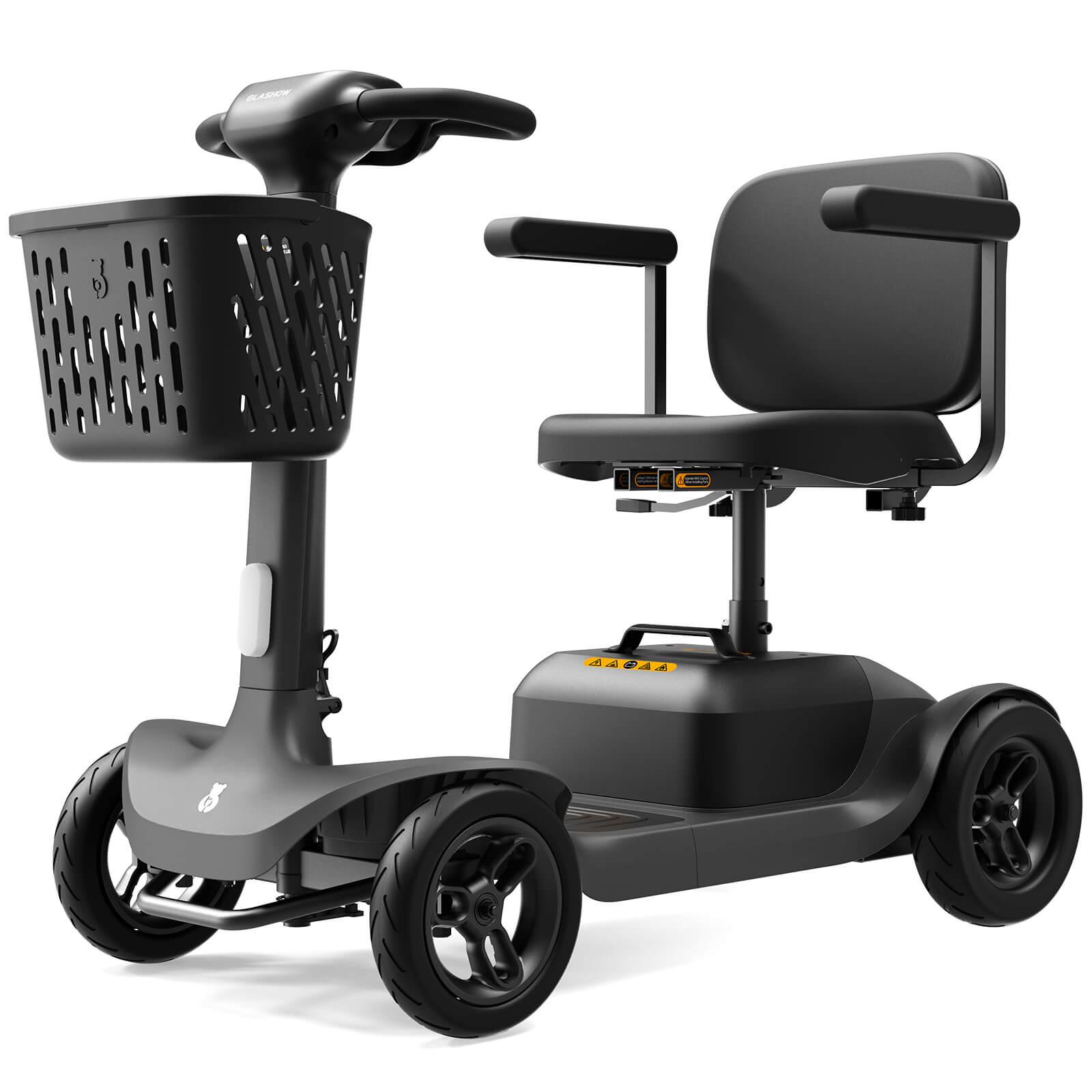
At Glashow, we've designed our scooters with American users in mind, balancing generous weight capacities with the portability that makes life easier. Let's look at how our two models compare:
| Specification | Glashow S1 | Glashow S3 |
|---|---|---|
| Price | $899 | $1,299 |
| Weight Capacity | 265 lbs | 265 lbs |
| Scooter Weight | 96.9 lbs | 70.48 lbs |
| Battery Type | Lead-Acid | Lithium-Ion |
| Range | Up to 15 miles | Up to 25 miles |
| Design | Detachable | Foldable |
| Warranty | 5-Year Frame | 5-Year Frame |
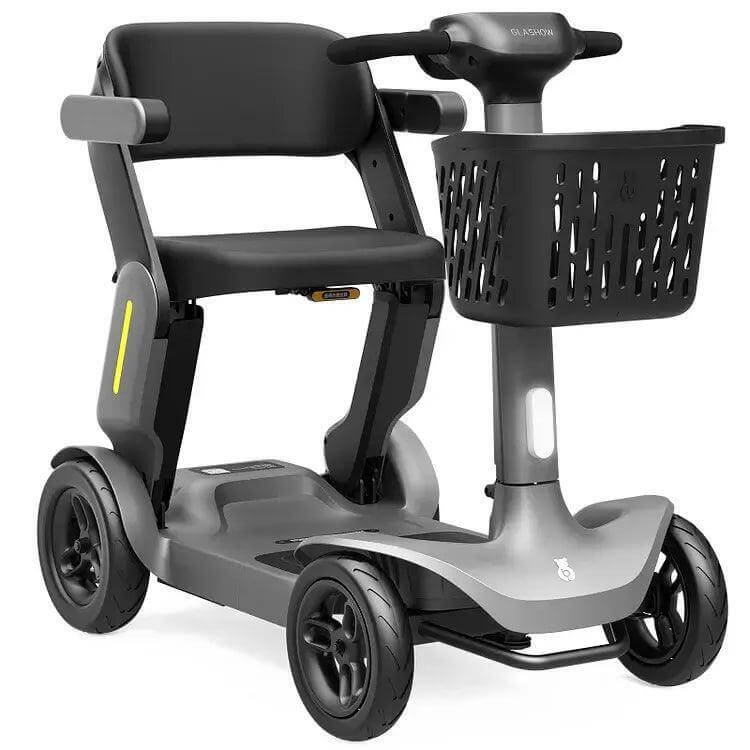
Both the Glashow S1 and Glashow S3 offer the same 265-pound weight capacity, but they serve different lifestyle needs. The S1 is our budget-friendly workhorse with a detachable design that's perfect for folks who don't need to lift the entire scooter at once. The S3, featured in USA Today, weighs just 70.48 pounds and folds in seconds — making it ideal for active seniors who travel frequently or have limited storage space.
How to Determine the Right Weight Capacity for Your Needs
Choosing the right weight capacity involves more than stepping on a scale. Here's my advice for making the best decision:
1. Be honest about your current weight. I know this can be a sensitive topic, but accuracy here ensures your safety and satisfaction. Your scooter should support you comfortably, not at its maximum limit.
2. Consider weight fluctuations. Our bodies change over time. If you're working on health goals or your weight tends to vary, give yourself some buffer room in the capacity.
3. Add up your cargo. Think about what you typically carry — a purse might be 5 pounds, groceries could add 20-30 pounds, and medical equipment varies widely. These all count toward the total load.
4. Think about the terrain. If you'll be tackling hills, uneven sidewalks, or rougher terrain, staying well under the maximum capacity helps maintain performance and safety.
5. Plan for the future. A mobility scooter is an investment. Consider not just your needs today, but where you might be in a few years.
The Connection Between Scooter Weight and User Experience
Here's something many shoppers overlook: the scooter's own weight matters just as much as its capacity. A heavy scooter might support more weight, but it can create challenges for transport and storage.
The Glashow S3 addresses this beautifully. At just 70.48 pounds with its advanced lithium battery, it's light enough for most caregivers to lift into a car trunk. Compare that to some heavy-duty scooters that weigh 200+ pounds and require vehicle lifts or ramps.
For many users, a lighter scooter that comfortably supports their weight offers more freedom than a heavier model with excessive capacity they'll never use. It's all about finding that sweet spot.
Frequently Asked Questions About Mobility Scooter Weight Limits
What happens if I exceed my mobility scooter's weight limit?
Exceeding the weight limit puts stress on the motor, frame, and battery, leading to reduced performance, faster wear, and potential safety hazards. Your braking distance may increase, and the scooter may struggle on inclines. Additionally, operating beyond the specified capacity typically voids your warranty, leaving you responsible for any resulting damage or repairs.
Does the weight limit include items I'm carrying?
Yes, absolutely. The weight capacity refers to the total load on the scooter, including your body weight plus any items in baskets, bags, or pouches. If you weigh 220 pounds and regularly carry 30 pounds of groceries, you need a scooter rated for at least 250 pounds — though I'd recommend even more buffer for optimal performance.
Can I upgrade my scooter to handle more weight?
Generally, no. The weight capacity is determined by the integrated design of the frame, motor, and components. While you can upgrade certain parts like batteries for better range, you cannot safely increase the weight limit. If your needs change significantly, it's safer to invest in a scooter designed for higher capacity from the start.
Why do some lightweight scooters have lower weight capacities?
It comes down to engineering trade-offs. Lightweight, portable scooters prioritize easy transport and storage, which means using lighter materials and more compact components. While modern materials are incredibly strong, there are physical limits to how much weight a 70-pound scooter can safely support compared to a 150-pound heavy-duty model. That said, models like the Glashow S3 use advanced engineering to maximize capacity while minimizing weight.
How do I know if a weight capacity rating is accurate?
Reputable manufacturers test their scooters thoroughly and provide accurate specifications. Look for brands that offer strong warranties — like Glashow's 5-year frame warranty — as this indicates confidence in their engineering. Reading verified customer reviews from users of similar body types can also give you real-world insight into how the scooter performs near its rated capacity.
Ready to Find Your Perfect Mobility Scooter?
Understanding mobility scooter weight limits is the first step toward regaining your independence and getting back to the activities you love. Whether you're exploring your neighborhood, visiting grandkids, or simply running errands without asking for rides, the right scooter makes all the difference.
At Glashow, we're proud to offer American-designed mobility scooters that combine quality engineering with thoughtful features. Both our S1 and S3 models come with our industry-leading 5-year frame warranty, free shipping anywhere in the USA, and a 30-day money-back guarantee so you can try your scooter risk-free.
Worried about the upfront cost? We've partnered with Klarna to offer 0% APR financing, letting you spread payments over time without any interest. Because everyone deserves the freedom that comes with reliable mobility.
Browse the Glashow S1 starting at $899 or explore the lightweight, foldable Glashow S3 at $1,299. Both ship free to your door, and our friendly customer service team is always here to answer your questions. Your independence is waiting — let's help you get there.